
The Platforms context contains a set of algorithmic or model-based tools.
The Platform Context allows you to run specific native algorithms helpful when performing High dimensional data analysis. After identifying a population of interest, select it in the Population panel of the Analysis tree (Figure 1.1), click on the Platforms icon in the navigation bar (Figure 1.2) and select which platform you would like to run. As of FlowJo v11.2, the algorithm options include t-SNE or UMAP for dimensionality reduction, and X-shift or FlowSOM for clustering (Figure 1.3). The Platform options will open in the Discovery panel. (Figure 1.4).
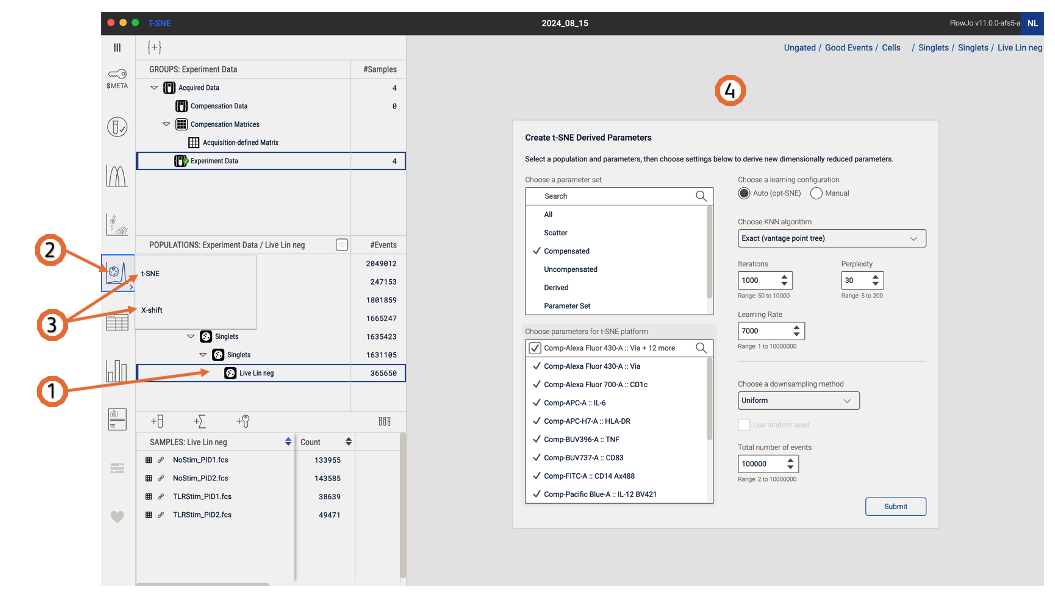
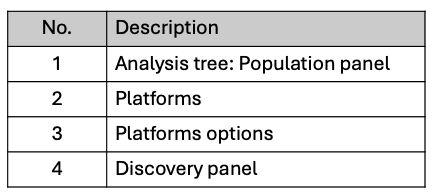
Figure 1. Platforms
There are currently two platforms included:
- t-SNE - Dimensionality reduction - T-Distributed Stochastic Neighbor Embedding with opt-SNE1.
- UMAP - Dimensionality reduction - Uniform Manifold Approximation and Projection2.
- X-Shift - Clustering - fast K-nearest neighbors density estimation3.
- FlowSOM - Clustering - self organizing maps4.
1Belkina, A.C., Ciccolella, C.O., Anno, R. et al. Automated optimized parameters for T-distributed stochastic neighbor embedding improve visualization and analysis of large datasets. Nat Commun 10, 5415 (2019).
2McInnes, Healy. UMAP: Uniform Manifold Approximation and Projection for Dimension Reduction. Feb 2018. arXiv:1802.03426.
3Samusik N, Good Z, Spitzer MH, Davis KL, Nolan GP. Automated mapping of phenotype space with single-cell data. Nat Methods.13(6):493-6 (2016).
4Van Gassen S, Callebaut B, Van Helden MJ, Lambrecht BN, Demeester P, Dhane T, Saeys Y. FlowSOM: Using self-organizing maps for visualization and interpretation of cytometry data. Cytometry A. 2015; 87(7):636-45.